Heroes of Horror (2005) is full of storytelling gems
I made a little bit of money as a child - allowance, gifts, so on. And I was quite good at avoiding spending on temporary frivolities until I had saved up for something special. While I played video games, I didn't play them often enough to justify using my limited funds on them. I loved reading too, but my parents just bought books for me outright if they could swing it, there was the library, or I could just read things off my computer.
No, usually, this saved money went into Dungeons and Dragons 3.X Edition books.
I played DnD sporadically through high school, but was more in love with it as a concept. I loved Baldur's Gate, Neverwinter Nights, and R.A. Salvatore. I loved the Dragonlance books, and everything about this specific subculture. I would purchase books, and just read them. I still have many of those old books on my bookshelf.
But one of my favorites of these is still Heroes of Horror.
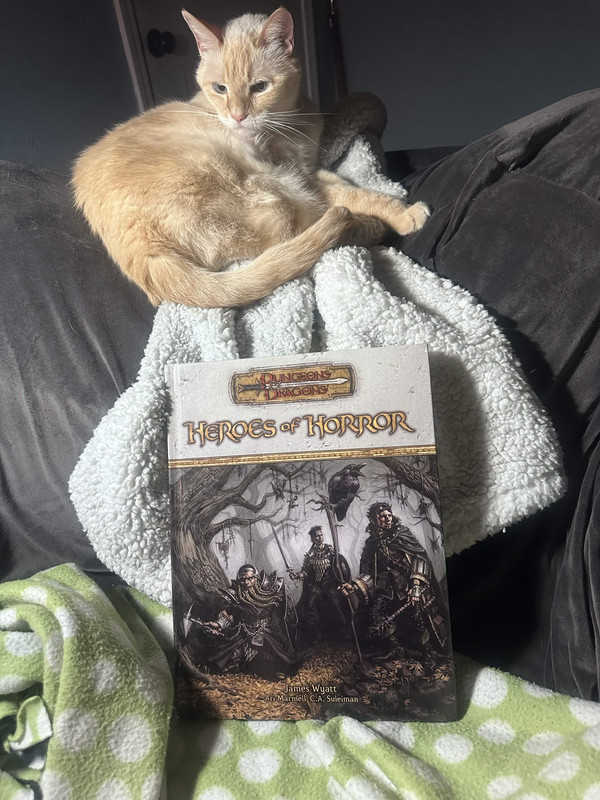
Heroes of Horror was released in October of 2005 - my senior year of high school. I remember having this book around Halloween, so I might have bought this almost as soon as it hit the shelves of my local Hastings Entertainment.
Heroes of Horror took one fascination of mine - Dungeons and Dragons - and mixed it with another fascination of mine - horror. This book has a mixed legacy for its attempt to work out mechanics like Call of C'Thulhu's Sanity subsystem to fit within the DnD framework. You can clearly see what they're going for, and also why it doesn't work. But, as a teenager who had only theoretically played DnD, these mechanical flaws didn't bother me as the fluff surrounding it was what I was focused on.
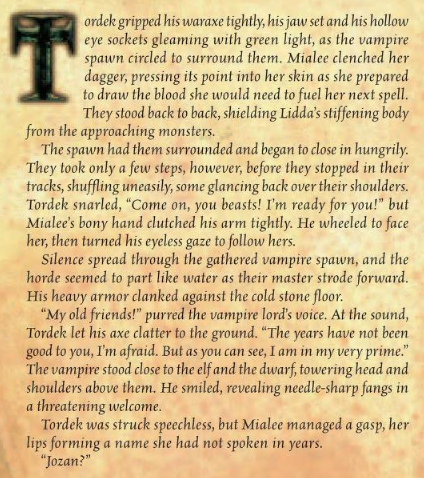
The book starts with the scene right out of dark horror to set a strong tone. This is a strategy I don't remember seeing many DnD books employ. I flipped through a few of my old books, but turned up empty. It goes a long way toward building credibility for what this book is actually good at: ambience.
It's a shame these scene writings are not used more. World of Darkness uses it to great effect in their source books.
The Good: Storytelling Tools
The part of this book that still makes it worthwhile to me are the GM storytelling tools. Horror is all about building up tension. Spectacle is one thing - anyone can do a jump scare. But horror is dread and uncertainty.
"One of the things that players find truly frightening is when a DM uses the unexpected. Fear of the unknown is perhaps greater than any other fear, and that kind of wellspring shouldn't be ignored." (pg. 8)
There are several terrifying tables of frightening fates and diabolical details to set an electrifying environment. Some of my favorites include:
- Two pages of creepy effects that include "Smoke trickles from a chimney, but when the PCs enter the fireplace is cold and dead" and "A character eating a piece of fruit discovers that the seeds he spits out are in fact human teeth."
- Villainous traits such as "Facial features slightly deformed or off-kilter" and "One eye is missing and there's a button sewn in the back of the gaping socket."
- A table of 'resurrection mishaps', to make players come back slightly wrong
There are also several sample encounters and villains that, while intriguing, are not mechanically exciting. Still, the ideas behind them provide an excellent showcase in raising tension in horror.
There are several pages about how to craft horror adventures, from making villains, choosing tragic motives, and crafting hard choices to put your party in. There's also a few paragraphs about the importance of player comfort and consent. It's like a seed of safety tools that have slowly become more standard at contemporary tables.
"To Go Only as Far as the Players Wish: Some people have a lower threshold for horror than others. No matter how horrific you wish to make it, DnD is still a game; it's meant to be fun. If one of your players is becoming uncomfortable with a scene or a description, stop." (pg. 40).
It also gives suggestions on how to adapt settings and non-horror adventures or campaigns into horror.
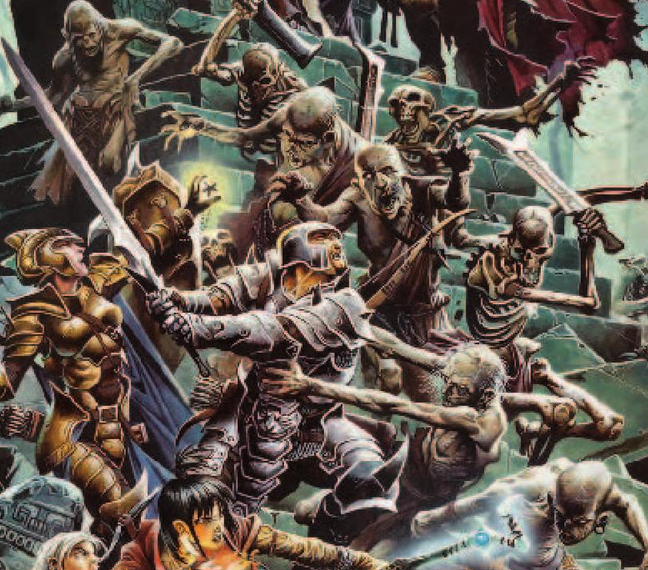
The first three chapters are the best part of the book.
Chapter 6 gets in to creatures of the night. There are suggestions for various genres and some really nasty looking potential enemies that can be pillaged for your own games, even if you ignore the mechanics. For example:
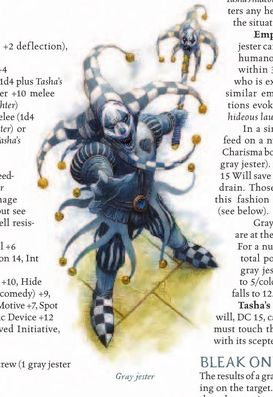
I've never run anything out of this book, but I've absolutely thrown this jester at players before. Another standout monster is the Unholy Scion, which is the subject of one of the adventures in the first chapter. I enjoy nuanced evil, but I like my BBEG villains to be irredeemable beings of pure malice.
"An unholy scion can also be created when a fiend mentally possess an unborn child within the womb." (Pg. 155)
Wait, does this PDF have a grammatical error?
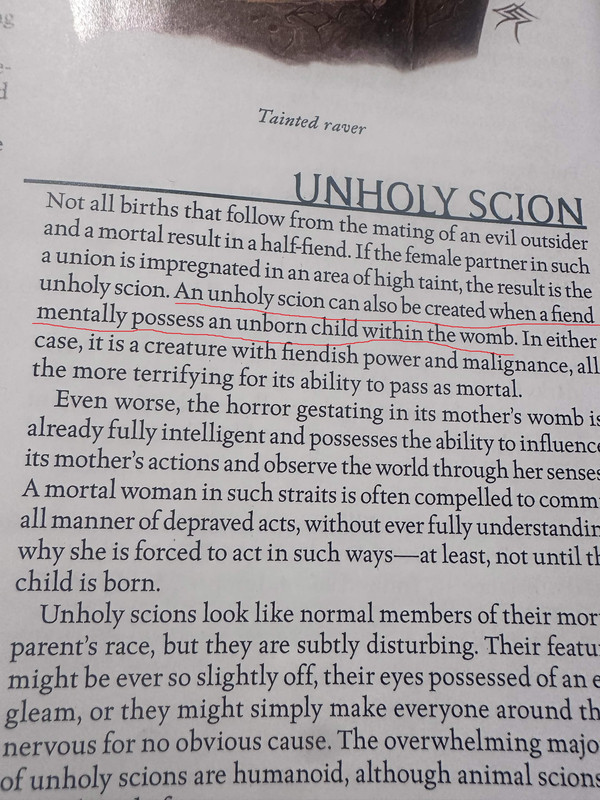
Holy shit, it's here too. I don't have much room to judge given my questionable copy-editing skills, but that's so fucking funny.
The Mediocre: The Rules
Heroes of Horror introduces several new systems that attempt to translate some cool ideas into DnD mechanics, and the results are a little clunky.
The Taint mechanic is a mechanic I want to love, but it works considerably better in a more roleplay-forward system. Some of the mechanics just feel unnecessary, as if trying to stretch for spaces. The biggest problem is that all of the additional rolling risks making the game slow down even more. 3.X was already clunky enough at times without introducing new rolls.
These should have honestly just been roleplay details without a significant mechanical drawback. Maybe a proper penalty if Taint got too high.
I truly do get the idea and they can be fun. But it works there because they are generally story first games.
All that being said, the story fluff around all these subsystems are great.
The classes and prestige classes that come in the book are quite interesting and thematic, including evocative artwork and suggestions for turning these classes into NPCs and how they may interact with the party. My favorite is this little fecker:
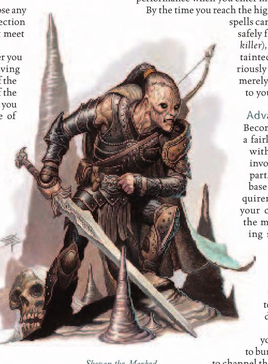
Corrupt avengers are anti-heroes who burn with a desire for vengeance even as they are consumed. Fallen paladins regain a twisted version of some of their powers back for pursuing this prestige class.
I can't speak much to the feats in the book, but 99% of feats in 3.X were hot garbage any ways, and I doubt this book bucked the trend. Just grab Exotic Weapon Proficiency (Spiked Chain), Combat Expertise, and call it a day.
Conclusion
Looking back through Heroes of Horror, I think it is still one of my favorite books. The tips on spooky storytelling are legitimately very good, and I think they can help to ameliorate some of the challenge that DnD and its genre of TTRPG posts to horror conventions. These systems are largely combat rules aimed at fulfilling a power fantasy. It's a fantasy super hero game in many ways.
You do have to take with a grain of salt that you likely won't get genuine fear out of your players. There are systems that do dread better.
I like injecting horror in my campaigns, but I also like having players feel powerful. I want the monster to be a genuine struggle, but also beaten.
But you can make your PCs a little less uncertain in their bravado if you can sell it. My group is currently exploring a haunted forest, and this book was pulled from my shelf when I was putting together the opening scene description:
"You see the profile of a woman in the otherwise empty cemetery. The sound of metal parting earth is regular like a metronome as she pours shovels full of dirt into a fresh grave. The barren, gnarled branches of the tree above her are crooked and hard, reaching upward to a black sky with too many stars."
Thank you for reading, if you made it this far~